.svg)


Business Process Management: The Lifecycle, and Where Most BPM Programs Stall
Most BPM programs design, model, and execute well. They stall at monitoring, the stage that needs evidence of how work actually ran, and the loop never closes.





On this page
Measure the work, not the signal.
See productive time and utilization by team, not just what looks active.
Key Takeaways
- Business process management is the discipline of designing, running, and improving how work gets done across an organization, using a repeatable lifecycle rather than a one-time project.
- The BPM lifecycle moves through five stages: design, model, execute, monitor, and optimize, with each stage feeding the next.
- Most programs move through design, model, and execute without issue, then stall before the monitor stage produces real evidence of how the process performed.
- Closing the loop means feeding that execution evidence back into design, which is what makes the optimize stage possible instead of leaving the lifecycle as a one-time process map.
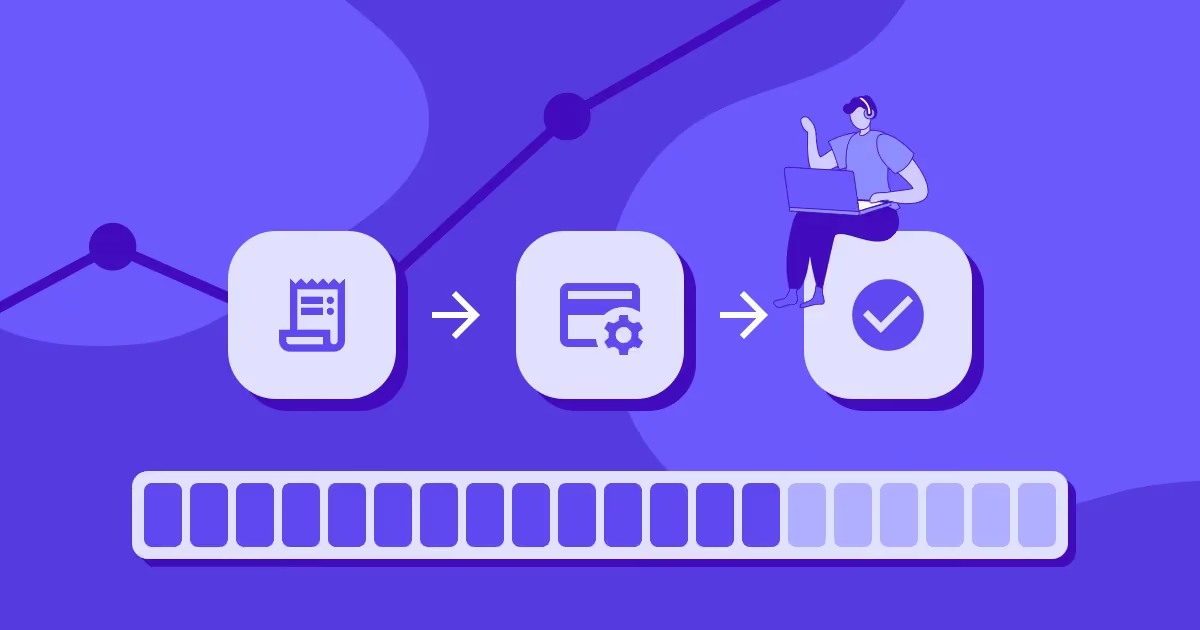
Business process management is usually drawn as a loop: design a process, model it, execute it, measure how it performs, and use what you learn to optimize the next cycle. The loop closes, the evidence from execution feeds back into design, and the process gets better each time around.
In practice, most organizations run it linearly instead. They design the process, model it, and execute it. Then the loop stops, one stage short of closing. It breaks at the monitor stage because measuring how a process actually ran requires evidence most systems were never built to produce.
Without that evidence, the optimize stage has nothing real to work from. Teams end up improving processes based on assumption or anecdote, not on what actually happened, which is a different exercise than the lifecycle was designed to support.
What Is Business Process Management?
Business process management is the discipline of designing, modeling, executing, measuring, and improving how work gets done across an organization. Rather than treating each process as a one-time project, BPM treats it as something to be continuously measured and refined, so that how work actually happens keeps improving over time, not just how it was originally designed.
That continuous cycle is what's known as the BPM lifecycle: a five-stage sequence of design, model, execute, monitor, and optimize. Each stage feeds the next. A process gets designed, translated into a model that can be tested or simulated, executed in real operations, measured at the monitor stage to see how it actually performed, and optimized based on what that measurement reveals.
The lifecycle applies at any scale, from a single department's approval workflow to an enterprise-wide claims or order-fulfillment process. What changes is not the structure of the lifecycle itself, but how rigorously each stage gets carried out. Many organizations handle design, model, and execute well, since those stages produce visible, tangible outputs: a documented process, a workflow diagram, or a live operation. The monitor and optimize stages are where rigor tends to drop off, because they depend on evidence that's harder to produce and easier to skip.
What Is a Business Process?
A business process is a set of related tasks, carried out in a defined sequence, that together produce a specific outcome for an organization or its customers. It has a clear start and end point, involves one or more people or systems, and repeats in a predictable way rather than happening once.
A few concrete examples make this easier to picture. Employee onboarding is a business process: it starts when an offer is accepted, moves through account provisioning, equipment setup, and orientation, and ends when the new hire is fully operational. Invoice-to-payment is another: it begins when an invoice arrives, moves through approval and matching against a purchase order, and ends when payment is issued. Customer complaint resolution is a third: it starts with an intake, moves through investigation and response, and ends when the issue is closed.
What connects these examples isn't their subject matter, but their shape. Each one has defined inputs, a repeatable sequence of steps, and a measurable outcome. That shape is what business process management is built to work with, whether the process in question takes ten minutes or ten days to complete.
The Five Stages of the BPM Lifecycle: Design, Model, Execute, Monitor, Optimize
The business process management lifecycle moves through five stages. Each one produces something specific, and each stage depends on what the previous one produced.
1. Design
Design is where a process gets defined. This stage produces a clear sequence of steps, the roles responsible for each step, the decisions or approvals required along the way, and the outcome the process is meant to achieve. A well-designed process can be explained to someone unfamiliar with it and still make sense, without needing the person who built it to walk them through it.
2. Model
Modeling takes the designed process and represents it in a form that can be reviewed, tested, or simulated before it runs in live operations. This stage produces a visual or logical representation of the process, often a flowchart or diagram, that makes it possible to spot gaps, bottlenecks, or redundant steps before they cost anything in practice. A model is also what makes a process comparable across departments, since two teams can review the same diagram and confirm they're actually describing the same workflow.
3. Execute
Execution is where the modeled process runs in real operations, carried out by the people and systems it was designed for. This stage produces the process in action: work moving through its intended sequence, decisions getting made, and outcomes getting delivered to whoever depends on them, whether that's a customer, another department, or a regulator. Execution is also where the gap between the model and reality first starts to open, even if no one is measuring it yet.
4. Monitor
The monitor stage is where the executed process gets measured against how it was designed to run. This stage produces evidence: how long each step actually took, where work stalled or moved out of sequence, and how consistently the process was followed across different people or teams handling the same work. That evidence is what makes it possible to know whether the process is working as intended, rather than assuming it is, and it's the stage most programs never fully complete.
5. Optimize
Optimization takes what the monitor stage revealed and feeds it back into the process design. This stage produces changes: a step removed, a handoff redesigned, a rule adjusted to reflect how work actually gets done. Those changes become the new starting point for the next design stage, which is what turns the lifecycle into a loop instead of a one-time project, provided the stage before it actually produced something real to work from.
Learn more: how to know which parts of the lifecycle are ready for business process automation, and the the BPM tools that support each lifecycle stage.
Where BPM Programs Stall
Most BPM programs don't fail at design, model, or execute. Those stages produce something visible: a documented process, a diagram, a live operation. The stall happens at the monitor stage, and it happens for a specific, avoidable reason.
The monitor stage is supposed to produce execution evidence: how long each step of the process actually took, where work moved out of sequence, and how consistently different people followed the same process for the same kind of work. That evidence is what the optimize stage depends on. Without it, there's nothing concrete to improve against, no matter how well-intentioned the team running the program is.
Most organizations don't have a systematic way to produce that evidence, so they substitute something else. Status reporting is the most common stand-in: a team lead confirms that a process ran, or a dashboard shows that a case was closed within a target window. Self-assessment is another: process owners report on how their own process performed, often from memory or a rough sense of how the quarter went, rather than from a record of what actually happened step by step.
Both of these feel like measurement. Neither one is evidence of how the process actually ran. Status reporting confirms an outcome, not the path that produced it. Self-assessment reflects how a process felt to the people running it, which is a different thing from how it performed. Neither can tell you that one team's version of a process takes twice as long as another's, or that a specific step is where most of the delay originates, or why that step keeps producing the same holdup quarter after quarter.
This is the failure pattern: a program reaches the monitor stage, produces something that looks like real measurement, and moves on to optimize without a real baseline underneath it. The optimize stage then runs on assumption. Someone has a theory about what's slowing the process down, based on impressions rather than evidence, and the "improvement" that follows is a guess formalized into a change.
The loop doesn't close at that point. It bends back toward design without ever having measured what execute actually produced. The program can run through all five stages on a slide and still never have closed the gap between the process as designed and the process as it's actually carried out.
Business Process Analysis
Business process analysis is the work of examining how a process functions today, identifying where it breaks down, and determining what should change. It sits between design and the monitor stage: it can happen before a process is designed, to understand a starting point, or after it's been running, to understand why it isn't performing as expected.
Analysis is often confused with mapping and with mining, but each does different work. Mapping documents the intended sequence of a process: the steps, the decision points, the handoffs between people or systems. It shows how a process is supposed to work. Mining, by contrast, extracts data from the systems a process runs through to reconstruct how it actually moved, based on system-level records or desktop-level activity. Analysis draws on both. It uses the map to understand intent and the data to understand reality, then interprets the gap between them.
That interpretation is the part mapping and mining alone don't provide. A map shows a four-step approval process. Mined data might show that step three routinely takes three times longer than the others. Analysis is what asks why, and what to do about it: whether the delay is a resourcing problem, a training gap, an unnecessary approval layer, or a sign the process was never realistic to begin with. To do that well, analysis needs a few specific inputs.
It needs the documented or modeled version of the process, so there's a baseline of intent to compare against. It needs data on how the process actually performed, whether that comes from system records, direct observation, or process mining tools. And it needs input from the people who run the process day to day, since they're often the first to recognize where a documented step doesn't match reality.
Process Excellence and Operational Excellence
Process excellence is the ongoing pursuit of improving how well a specific process performs, measured against standards like consistency, speed, and error rate. That's the core of what process excellence means in practice: not a one-time fix, but a standard a process is expected to keep meeting every time it runs. Where BPM provides the lifecycle for managing a process, process excellence is the standard that lifecycle is aiming for: a process that runs the same way every time, with minimal waste and minimal deviation, regardless of who's carrying it out.
Operational excellence is broader. It's an organizational philosophy that extends process excellence across every process in the business, tied to strategy rather than to any single workflow. An organization pursuing operational excellence isn't just trying to perfect one process. It's trying to build a culture and a set of systems where continuous improvement happens by default, across every function, not as a periodic project.
BPM is the mechanism. Process excellence and operational excellence are the outcomes BPM is meant to produce, at two different scales: one process at a time, or across the organization as a whole.
Most organizations pursuing operational excellence adopt an existing operational excellence framework rather than building one from scratch. Lean and Six Sigma are the two most common. Both share a similar structure: they define standards for how work should perform, provide methods for identifying deviation from those standards, and build in a repeatable cycle for closing the gap between current performance and the standard. Choosing a framework doesn't replace the need for BPM, though. A framework can define what "excellent" looks like and give teams a shared vocabulary for discussing it. It still needs a lifecycle, design, model, execute, monitor, optimize, to actually get a process there and keep it there over time, cycle after cycle.
Building a Process Center of Excellence
A process center of excellence is the group responsible for making process improvement a standing capability rather than a one-time project. It owns the standards a process should meet, the methods teams use to evaluate and improve their own processes, and the governance that keeps process changes from happening in an uncoordinated, ad hoc way across the organization.
Staffing is usually lean at the start. A typical center of excellence includes a lead who sets priorities and reports to leadership, a small group of process analysts who do the hands-on evaluation work, and a network of process owners embedded in individual departments, who aren't full-time members of the center but act as its point of contact within their own teams.
The first six months are usually about establishing a baseline, not launching a full program. That means documenting how a handful of high-priority processes currently work, choosing one or two to serve as a pilot rather than trying to standardize everything at once, and building the governance structures, who approves a process change, how changes get documented, how often a process gets reviewed, that the rest of the organization will eventually operate under.
By the end of that period, a center of excellence should have a working example of the full lifecycle applied to at least one real process, along with enough credibility from that pilot to expand its reach into the next one.
Closing the Loop
Every earlier stage of the BPM lifecycle produces something an organization can already see: a documented design, a model, a live process running in operations. What's missing is evidence of how that process actually performed, and that evidence is exactly what most organizations lack a systematic way to produce.
Workflow Optimization, the Insightful product, captures execution data, showing how a process actually ran rather than how it was designed to run. That is what closes the loop between the process as designed and the process as run, and it is what makes the optimize stage possible.
Without that evidence, optimize has nothing real to work from. With it, the gap between intent and execution becomes something concrete: a specific step where work stalls, a point where different teams handle the same process differently, a handoff that consistently takes longer than the rest. Those are the details a real baseline surfaces, and they're what turn the optimize stage from a guess into a change grounded in what actually happened.
This is scoped narrowly to capturing execution data, on purpose. Workflow Optimization doesn't design the process, model it, or execute it. It captures what happened during execution, which is the one piece of the lifecycle most BPM programs never manage to produce on their own.
Start with a Measured Baseline
The BPM lifecycle is drawn as a loop, but for most organizations it runs as a line that stops one stage short of closing. Design, model, and execute happen. The monitor stage doesn't, at least not in a way that produces real evidence, and without that evidence, optimize has nothing to work from.
Closing the loop starts with a measured baseline: knowing how a process actually runs, not just how it was designed to run. That's the piece most BPM programs are missing, and it's the piece that turns the lifecycle from a diagram into something that actually improves over time instead of staying the same shape it started in.
Workflow Optimization is currently in beta. Request beta access to see how your processes actually run.
FAQs
What is business process management?
Business process management is the discipline of designing, executing, measuring, and improving how work gets done across an organization. It's structured around a five-stage lifecycle: design, model, execute, monitor, and optimize. Each cycle is meant to feed evidence from execution back into design, so the process keeps improving rather than staying fixed after its first rollout.
What is a business process?
A business process is a defined sequence of related tasks that produces a specific outcome, with a clear start and end point. Employee onboarding, invoice-to-payment, and customer complaint resolution are all examples. Each has defined inputs, a repeatable sequence of steps, and a measurable result, regardless of how long the process takes to complete.
What are the five stages of BPM?
The five stages of the BPM lifecycle are design, model, execute, monitor, and optimize. Design defines the process. Model represents it for testing. Execute runs it in live operations. Monitor measures how it actually performed. Optimize feeds that evidence back into design, which is what turns the lifecycle into a repeating loop instead of a one-time project.
What is business process analysis?
Business process analysis examines how a process functions today and determines what should change. It draws on a documented or modeled version of the process as a baseline, data on how the process actually performed, and input from the people who run it day to day. That combination reveals not just where a process breaks down, but why.
What is process excellence?
Process excellence is the ongoing pursuit of improving how well a specific process performs, measured against standards like consistency, speed, and error rate. Frameworks like Lean and Six Sigma define what that standard looks like and provide methods for closing the gap between current performance and it. BPM supplies the lifecycle that gets a process there.
What is the difference between BPM and operational excellence?
BPM is the lifecycle used to manage an individual process. Operational excellence is a broader organizational philosophy that applies that same discipline across every process in the business, tied to strategy rather than to any single workflow. BPM is the mechanism; operational excellence is the outcome at an organization-wide scale.
What is a process center of excellence?
A process center of excellence is the group responsible for making process improvement a standing capability rather than a one-time project. It's typically built with a lead, a small team of process analysts, and process owners embedded across departments. Early efforts usually focus on documenting a few high-priority processes and running one or two as a pilot.
What is business process transformation?
Business process transformation is a fundamental redesign of how an organization's processes work, typically undertaken when incremental improvement through the standard BPM lifecycle isn't enough to meet a major shift in strategy, technology, or scale. Rather than optimizing an existing process, transformation replaces it with a substantially different one, often across multiple functions at once.

.webp)
.webp)
.webp)
