.svg)


Roadmap to Design & Align Hybrid Work



Talk to Sales
Our dedicated team is here to
answer all your custom needs.

Implementation Roadmap
Designing hybrid work is not a one-time policy decision. It is a phased process that starts with diagnostics and leads to sustainable adoption.
This roadmap outlines a clear path from understanding how teams work today to defining, piloting, and rolling out a hybrid model that fits your organization. Each phase includes clear goals and checkpoints to support alignment, testing, and confident scaling.
With this, you’ll be able to:
- Align leaders around a defined model
- Pilot practices with real feedback and metrics
- Train managers and launch supporting tools
- Monitor adoption and optimize continuously
Workforce visibility tools, employee surveys, and analytics platforms such as Insightful help add precision at each step, ensuring your hybrid strategy is not just approved, but applied and continuously refined.
Discover & Diagnose (Weeks 1-2)
Many hybrid strategies fall apart because they’re built on assumptions about productivity, employee needs, or space usage that don’t hold up in practice. You need a shared, objective view of how work actually happens today.
This phase gives you a reliable baseline. In two weeks, you’ll be able to see what’s working, where friction is building, and which constraints matter most.
This phase focuses on three areas:
- Work patterns & productivity
- Employee sentiment & preferences
- Space utilization & systems
{{down-1}}
[fs-toc-omit]Analyze Work Patterns & Productivity
Every team already follows natural rhythms shaped by meetings, focus time, collaboration, and daily activity patterns.
Before defining a structured hybrid model, you need visibility into those rhythms so policy decisions reflect how work actually gets done.
A work-pattern diagnostic helps you understand:
- How people work today, including meeting load, focus time, and context switching
- Where teams are already operating effectively
- Where overload or imbalance is creating friction
- Which deep-work windows and role-specific rhythms need protection
This becomes the baseline for designing a model that is realistic and sustainable
📥 Make sure you downloaded the Work Patterns Diagnostic here.
[fs-toc-omit]Diagnose How Work Really Happens
You do not need complex analytics to start. Even basic data sources can reveal actionable insights, and tools like Insightful can automate much of this analysis.
Focus on four inputs:
- Calendar & meeting data → meeting load vs. focus time across teams
- Interruptions & context switching → common sources and impact
- Role & location differences → how managers, ICs, remote, and in-office teams vary
- Daily activity peaks → natural collaboration windows
Use these insights to guide choices around core hours, async practices, and team-level flexibility norms.
[fs-toc-omit]Assess Employee Sentiment & Preferences
Policies do not stick unless employees believe they are fair, flexible, and shaped with their input. Before defining a hybrid model, you need to understand how people experience their workload, flexibility, and communication norms.
A sentiment diagnostic reveals:
- How employees feel about workload, stress, and fairness
- Where preferences differ across teams or locations
- What employees want to see changed
- Where trust is being built or eroded
These insights help you design a model employees are more likely to adopt.
📥 Download the Employee Sentiment Survey here.
[fs-toc-omit]Diagnose Sentiment & Work Preferences
Collect employee input in a simple, structured way so feedback is consistent and comparable.
Focus on three inputs:
- Survey results → workload, flexibility, communication norms, fairness
- Focus groups → deeper examples and nuance surveys don’t capture
- Manager feedback → stress patterns, bottlenecks, morale shifts across teams
Compare results by role, team, and location to spot patterns and friction points. Share early themes with leaders to align before finalizing and use them to shape your hybrid design priorities.
[fs-toc-omit]Audit Space Utilization & Systems
Hybrid work changes how offices and tools are used. Spaces designed for daily attendance often see uneven demand, and systems that worked in-office may not scale well for distributed teams.
A space and systems audit shows:
- How the office is used today (attendance patterns, peak days, empty zones)
- Where collaboration breaks down (outdated or duplicate tools, low adoption)
- What can be optimized (desk allocation, room design, tool consolidation)
- Where policy and practice don’t match (anchor days, booking rules, async norms)
This gives you the operational baseline needed to design a model your infrastructure can actually support.
[fs-toc-omit]Audit How Space & Systems Are Used
Use simple attendance logs and system data to understand real usage patterns.
Focus on:
- Attendance & desk bookings → daily demand, peak days, unused space
- Zone usage → which rooms are always full vs. always empty
- Systems audit → communication tools, booking systems, duplicates, adoption
- Policy alignment check → where behavior diverges from expected norms
Share early findings with IT, Facilities, and People Ops to validate insights and surface areas for streamlining space and systems.
Design & Align (Weeks 3–5)
Once you have a baseline, the next step is turning those insights into real policy options. This phase helps you translate findings into workable models, weigh trade-offs, and align leaders on a direction you can actually pilot.
Skipping this stage leads to one-size-fits-all policies that look good on paper but fall apart in practice. Design & Align avoids that by giving leaders concrete models to react to—not opinions or assumptions.
This phase focuses on three areas:
- Policy model options
- Trade-off analysis
- Leadership alignment
Together, these steps give you a clear, evidence-based direction that’s ready for piloting.
[fs-toc-omit]Determine Role Eligibility
Determining which roles are eligible for hybrid work is a foundational step in building a fair, scalable model.
A clear, role-based system ensures consistency, prevents compliance risks, and helps employees understand the “why” behind policy decisions.
📥 Get an Eligibility Matrix you can use right here.
Use the Eligibility Matrix to assess each role across three decision points:
- Remote Eligibility — Can the role be performed remotely?
- Office Frequency — How often is in-office presence required?
- Approval Requirements — Are there any conditions or oversight steps?
👉 Read more:The Data-Driven Way to Decide Who Works Where
[fs-toc-omit]Compare Policy Trade-Offs
Once roles are defined, the next step is comparing hybrid policy approaches. Every model involves trade-offs between flexibility and consistency, autonomy and coordination, and equity and efficiency.
Comparing options side by side helps leaders:
- Evaluate operational feasibility
- Identify risks across compliance, culture, and productivity
- Align around data-backed decisions
[fs-toc-omit]Do a Side-by-Side Comparison of Policy Options
Use a side-by-side model comparison matrix to assess options across impact areas.
Compare models by:
- Operational feasibility → Tech, tools, and space needs
- Cultural alignment → Inclusion, team norms, and rituals
- Business risks → Compliance, legal exposure, and cost
- Performance potential → Productivity, engagement, burnout
Feed in audit findings, employee data, and diagnostics to quantify trade-offs by team or function. Use the completed matrix to frame leadership alignment discussions.
[fs-toc-omit]Set Core Hours & Communication Norms
Without predictable overlap, meetings stretch across time zones, decisions lag, and collaboration suffers. Core hours fix this—providing a shared window for live collaboration while protecting focus time.
[fs-toc-omit]How to Set Core Hours
Each team should define its own core hours, ideally:
- Ensuring 4+ hours overlap with their primary time zone or HQ
- Limiting to no more than 50% of the workday
- Using async tools (Slack, Notion, Loom) outside of core hours
- Proposing custom windows with manager sign-off
📝 Example: 11:00 AM–3:00 PM EST for U.S.-based teams
👉 Read more: How to Set & Manage Core Hours in Hybrid Teams
[fs-toc-omit]How to Set Communication Norms
Clear communication norms prevent overload and help hybrid teams stay aligned across locations and time zones. Define expectations early so teams know how and when to connect.
Focus on setting:
- Core hours and availability expectations
- Clear guidance on when to use sync vs. async communication
- Meeting norms and response timeframes
- Quiet hours that protect focus and reduce interruptions
👉Read more: How to Set and Scale Communication Norms for Hybrid Teams.
[fs-toc-omit]Standardize Desk Booking & Office Use
Once schedules are set, in-office access needs to be structured. Without clear rules, office days become unpredictable and inefficient.
Standardized desk booking helps create fairness and coordination across teams. Clear guidelines reduce confusion, improve space utilization, and make office time more intentional.
Use the Desk Booking SLA to create a consistent experience across teams and locations. It covers:
📥 Download the Desk Booking SLA here.
[fs-toc-omit]Align Leadership
The final step in this phase is bringing leaders together to review the options, debate the trade-offs, and make a unified decision. Without alignment at this stage, even the best policy models will stall at rollout.
This is not just about gaining approval—it’s about securing commitment to pilot, support adoption, and lead by example.
Leadership alignment sessions should:
- Present 2–3 viable hybrid models
- Surface trade-offs and unresolved concerns
- Drive to a decision on the pilot direction
You’ll also use this moment to assign accountability for the next steps.
[fs-toc-omit]How to Facilitate Leadership Alignment
Plan a dedicated decision-making session with the right pre-reads and roles.
Focus on four inputs:
- Work patterns, sentiment, and space insights
- Policy model options (2–3)
- Trade-off matrix
- Pilot scope and success metrics
Use a neutral facilitator and decision log to keep things structured and outcome-focused.
Next: Pilot, Test, & Refine Your Hybrid Model
You’ve aligned on a hybrid approach. The next step is proving it works in real conditions.
Continue to Section 2 to test your model with real teams, gather feedback, manage risk, and refine before rollout.


Hybrid Policy Falling Apart in Practice?
Stop guessing. Get clear, real-time visibility into how work actually happens.



Works Where Your Team Does
Support well-being across Windows, macOS, and Linux.
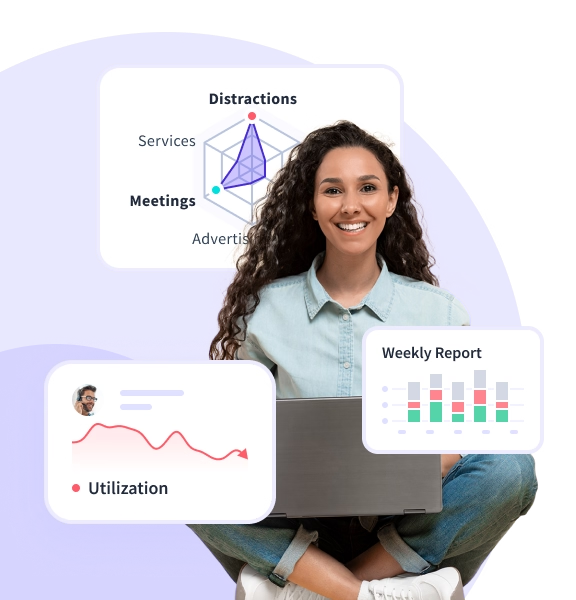
Clarity for Hybrid Teams
Insightful shows how work happens day to day.

Recommended for You
Turn strategy into action. Test your hybrid model, manage risk and compliance, and refine it before scaling.


Define ownership, decision-making, and accountability to keep hybrid work consistent, fair, and compliant over time.
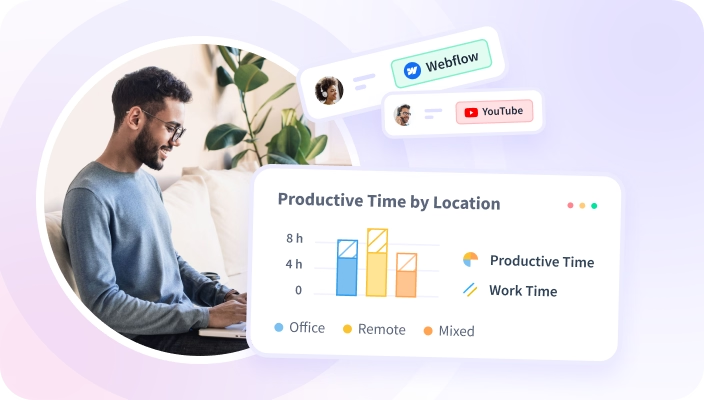
See how visibility and data help teams maintain performance, equity, and compliance as hybrid work operates daily.