.svg)


10 Best Healthcare Performance Management Tools for Back-Office and Admin Teams (2026)
The best healthcare performance management software balances visibility with strict confidentiality and security features. See how the top 10 tools stack up.





On this page
Measure the work, not the signal.
See productive time and utilization by team, not just what looks active.
Key Takeaways:
- HIPAA compliance is a fundamental consideration for healthcare organizations in the United States. Features like configurable access permissions, data encryption, and adherence to global security standards are critical.
- On-premise deployment options are another consideration for organizations in highly regulated industries like healthcare.
- The best performance management platforms balance visibility and in-depth work insights with strict privacy controls.
Admin and back-office teams for healthcare organizations face any number of challenges unique to the industry, from complex billing to medical coding, claims, scheduling, and confidential patient record handling.
That means that performance management software for healthcare teams has to match that level of specialization. And not all time tracking, employee monitoring, or productivity software is created equal when it comes to healthcare admin teams.
This guide looks at the best productivity monitoring tools through the lens of healthcare back-office teams. It considers critical features like time and attendance tracking and employee monitoring, and presents ten options particularly well-suited for the healthcare industry, considering everything from price to optimizations for HIPAA compliance.
Why Healthcare Back-Office and Admin Teams Need Dedicated Performance Management Tools
Back-office healthcare functions like billing specialists, medical coders, and claims processors generate an enormous amount of measurable output. With the right performance management tools, leaders can directly quantify KPIs like the gap between expected and actual productivity.
That data can come with compliance risk, however. Tools that capture screenshots can inadvertently record protected health information (PHI) from EHR, billing, and scheduling screens, creating HIPAA exposure unless the tool either avoids screen capture entirely or signs a Business Associate Agreement (BAA). Labor costs account for approximately half of a hospital's operating budget, making workforce efficiency a direct P&L concern; the time and attendance data underpinning that analysis is only reliable when captured passively, not manually.
Learn more about workforce performance management best practices.
Quick Comparison: Healthcare Performance Management Tools for Back-Office and Admin Teams
10 Best Healthcare Performance Management Tools for Back-Office and Admin Teams: Full Reviews
1. Insightful
Best for: Healthcare organizations needing comprehensive work insights, configurable screenshot monitoring, on-premise deployment (250+ seats), and features designed to ensure full HIPAA compliance.
Insightful offers a dedicated healthcare industry page and a number of purpose-built features. In addition to automated timesheets and real-time productivity dashboards, Insightful grants admins the ability to fully disable or blur screenshots, and exclude specific apps or websites (e.g., an EHR or billing system) from monitoring. In Settings, teams can simply select "Yes, I collect PHI data," which activates HIPAA-specific safeguards.
For organizations with remote billing and coding staff, location insights surface output differences across in-office and remote teams without manual check-ins.
At Caduceus Health, a revenue cycle management company handling billing and scheduling for major healthcare providers, Insightful helped cut call abandonment from 14% to 3% and lifted productivity by 20% across its 200+ remote staff. As Grant Knaggs, Chief Operating Officer, put it: “Insightful’s a tool that helps us understand the when, where, and what of problems.”
Pros: Configurable screenshot/data-capture controls; on-premise deployment available (250-seat minimum); role-based access permissions; adheres to SOC 2 and ISO 27001 standards; AES-256 encryption at rest and TLS 1.2 in transit; access controls like SSO and two-factor authentication; configurable screenshot/data-capture controls; no keystroke logging or personal communications capture; comprehensive work insights focused on improving operations and driving efficiency.
See how Oklahoma Heart Hospital's IT team cut an 80-hour assessment process to 30 minutes.
2. WorkTime
Best for: Healthcare organizations conscious of PHI exposure risk. HIPAA-safe mode for regulated environments requires the Enterprise plan.
WorkTime captures no screen content, keystrokes, or clipboard data; only numerical metrics: productivity scores, active time, and attendance patterns.
One important plan distinction: WorkTime’s HIPAA-safe mode is available on the Enterprise plan only; Basic and Premium do not include it. Pricing starts at $6.99/user/month (monthly) for Basic. On-premise and cloud deployment are both available.
Pros: No screen content, keystrokes, or clipboard data collected on any tier; on-premise deployment available; HIPAA-safe mode on Enterprise plan.
Cons: Limited workforce analytics depth beyond productivity scores and attendance patterns; teams needing deeper workload distribution or project-level data may outgrow it.
3. Time Doctor
Best for: Back-office teams handling billing, insurance verification, claims, and outsourced administrative work that need audit-ready records.
Time Doctor offers audit-ready time and attendance records, especially useful for billing, insurance verification, and claims teams; optional screenshots support audit documentation without making them mandatory. Integrations with QuickBooks, ADP, and Paychex connect tracked time to payroll and billing workflows. Basic plan starts at $6.67/user/month (annual) or $8/user/month (monthly).
Pros: HIPAA, GDPR, and SOC 2-aligned controls; optional screenshots for audit support; EHR, billing, and payroll integrations; role-based access controls; 14-day free trial.
Cons: Cloud-only, no on-premise deployment, a constraint for organizations that require local data storage for compliance reasons.
4. ActivTrak
Best for: Back-office teams focused on workload analytics across billing, coding, and claims departments.
ActivTrak offers productivity dashboards, application-usage tracking, and workload-balance insights that help operations leaders more clearly see staff capacity. ActivTrak supports HIPAA compliance configuration, and screenshots are a paid add-on (part of the Screen Details package).
Cloud-only, no on-premise option. Free plan for up to 3 users; paid plans from $10/worker/month (annual billing only, no monthly option).
Pros: Clear dashboards; application-usage analytics; SOC 2 Type 2 certified; HIPAA compliance configuration supported; free tier for very small teams.
Cons: Cloud-only, no on-premise deployment; screenshots are a paid add-on.
5. Teramind
Best for: Organizations where data-loss prevention and insider-risk detection are as important as productivity monitoring.
Teramind offers screen recording, file-transfer tracking, and behavioral analytics for insider-threat and data-exfiltration risk. On-premise deployment is available. Starter plan is $14/user/month.
Pros: Deep monitoring features; on-premise deployment available; a range of DLP features.
Cons: Features like email monitoring, instant message monitoring, and keystroke logging can be met with resistance from employees.
6. TCP Software
Best for: Organizations that need full-featured shift scheduling and time-and-attendance compliance across clinical and administrative staff.
TCP Software (TimeClock Plus and Humanity Schedule) is a scheduling and time-and-attendance platform, not a comprehensive employee monitoring tool. It is included because scheduling and shift compliance are core back-office management needs in healthcare; TCP serves major organizations in the industry with those features.
Built-in overtime, break, and max-shift-length compliance rules and automated payroll calculations make it a real consideration when shift management is the primary need.
Pros: Purpose-built for healthcare scheduling; proven with major health system clients; built-in overtime and shift compliance rules; biometric time clock options.
Cons: Not a true productivity monitoring tool: no screen monitoring, app tracking, or workload analytics. An unlikely fit If workforce visibility beyond attendance is the goal.
7. Hubstaff
Best for: Home health agencies, mobile billing and intake staff, or field-based administrative roles needing location verification alongside time tracking.
Hubstaff pairs GPS tracking and geofencing with time tracking, making it a potential fit for home health agencies, mobile billing and intake staff, or field-based administrative roles needing location verification alongside tracked hours. It is SOC 2 Type II compliant and offers granular access controls. Pricing starts at $4.99/user/month (annual billing). No on-premise deployment. GPS tracking is an add-on on lower-tier plans.
Pros: SOC 2 Type II compliant; GPS tracking and geofencing for field staff; granular access controls; exportable audit trails; optional screenshots.
Cons: Cloud-only, no on-premise deployment; Locations features are an add-on to the higher Team plan, and unavailable on Starter and Grow plans.
8. TimeBee
Best for: Smaller healthcare practices looking for a combined time tracking, scheduling, and billing tool with optional screenshot monitoring.
TimeBee positions itself as a productivity and scheduling tool well suited for healthcare practices. It tracks billable and non-billable hours, includes optional screenshots, and handles scheduling and payroll calculation. Pricing is custom; a 14-day free trial is available.
Pros: Billable/non-billable hour tracking; scheduling and payroll features included; 14-day trial.
Cons: No publicly listed per-user rate means that pricing requires a sales conversation with the vendor.
9. eBillity
Best for: Billing and revenue-cycle teams needing time tracking tied closely to scheduling and payroll workflows.
eBillity (Time Tracker) offers time tracking, scheduling, and client billing features, with a dedicated healthcare page aimed at billing specialists across multiple patient locations. Its time clock kiosk uses facial detection to reduce buddy punching; GPS location tracking supports mobile staff. Pricing starts at $8.00/user/month for its entry plan with limited features. eBillity is a scheduling and time-tracking tool, not a dedicated workforce activity monitor; no screen monitoring available.
Pros: Scheduling and client billing features built in; GPS location tracking for mobile staff; time clock kiosk with facial detection.
Cons: No screenshots or comprehensive workforce productivity analytics available.
10. Buddy Punch
Best for: Small healthcare practices or home care agencies needing affordable shift tracking and GPS clock-in.
Buddy Punch is a cloud-based time clock and scheduling platform used across industries. It handles GPS tracking, geofencing, facial recognition clock-in, PTO accruals, and payroll integrations. Plans start at $4.49/user/month plus a $19/month base fee, with a 14-day free trial.
Pros: User-friendly interface; GPS tracking and geofencing for field staff; facial recognition clock-in; flexible punch options; affordable entry price.
Cons: Cloud-only; focused on time and scheduling rather than employee monitoring or comprehensive performance management.
Key Features to Look for in Healthcare Performance Management Software
Automated Time Tracking Without Manual Entry
Passive tracking of active time, idle time, and scheduled hours removes the manual input burden from billing, coding, and scheduling staff and produces cleaner data than timer-based approaches.
Attendance and Shift Compliance
Shift-compliance alerts, overtime tracking, and attendance monitoring across multiple locations matter in healthcare, where labor costs account for a major portion of a hospital's operating budget and overtime exposure compounds quickly.
Burnout and Overwork Detection
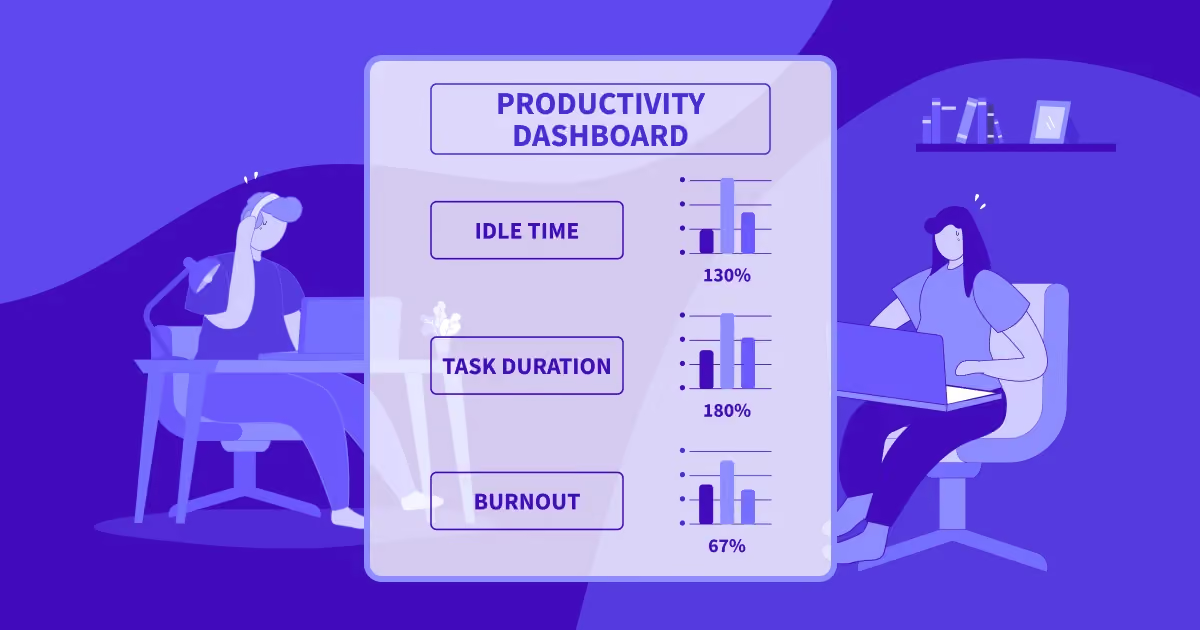
Tools that provide visibility on extended hours, overtime patterns, and declining utilization give operations leaders early-warning signals before attrition spikes. For billing and coding teams, detecting imbalance early is cheaper than replacing people who leave.
Deployment Flexibility
Organizations handling PHI on internal networks may require on-premise deployment. Insightful, WorkTime, and Teramind support on-premise hosting. Insightful's on-premise page covers deployment requirements in detail.
Conclusion
Back-office healthcare teams need visibility into how administrative work actually happens: where time goes, whether workloads are balanced, and whether remote billing and coding staff produce at the same rate as in-office teams. Security controls and features purpose built to ensure HIPAA compliance are the real differentiator among platforms on this list.
Insightful offers a strong balance of compliance features with in-depth work data showing how work actually happens. The Workforce Analytics 7-day free trial includes full feature access with no credit card required.
FAQs
What is healthcare performance management software?
The term generally refers to workforce management and time tracking software for back-office and admin staff: billing, coding, claims, and scheduling teams.
Can these tools monitor clinical staff as well as back-office staff?
Some can, but this guide is scoped to back-office and administrative teams. Monitoring clinical staff raises different practical considerations that should be compared against regulations in the region where an organization operates.
How much does healthcare time tracking software cost?
Confirmed starting prices range from $4.99/user/month to $14/user/month, though many platforms offer key features for healthcare organizations only at higher tier levels. Insightful starts at $8/seat/month for its Workforce Analytics plan, offering a more comprehensive set of features at the entry level than virtually any other platform on this list.
.webp)
.webp)
.webp)
