.svg)
Most Workflows Are Unmapped: What It’s Costing Your Business
Unmapped workflows reduce capacity, hurt margins, and create hidden burnout. Learn how leaders fix workforce productivity gaps with better visibility.






On this page
Measure the work, not the signal.
See productive time and utilization by team, not just what looks active.
Key Takeaways:
- An unmapped workflow is any recurring process operating without clear visibility, documentation, or measurable data across the organization.
- Unmapped workflows drive avoidable capacity loss, with a 200-person team potentially forfeiting over 25,000 paid hours annually.
- Without workflow visibility staffing decisions become reactive, leading to uneven work distribution and inflated operating costs over time.
- Burnout caused by unmapped workflows concentrates at invisible bottlenecks, becoming visible only after top performers leave the organization.
- Fixing workflow visibility requires operational instrumentation, focusing first on the highest-cost processes with the most downstream impact.
Most workflows inside your organization are unmapped, and that’s not an operational inconvenience; it’s a financial liability. When a COO or CFO lacks visibility into how work actually flows, every decision about staffing, budgeting, and efficiency is built on assumptions rather than data.
In an environment where even a 1–2% shift in operating efficiency can materially impact margins, this blind spot compounds quickly. What looks like a productivity issue is often a visibility problem, and it’s costing you more than you think.
What Does “Unmapped Workflow” Actually Mean?
An unmapped workflow is any recurring process that happens inside your organization without clear visibility, documentation, or measurable data. Leadership knows the outcome, but not the path it takes to get there.
This is different from an outdated process. An unmapped workflow isn’t wrong; it’s invisible.
For example, a customer support escalation might move from a ticketing tool to Slack, then to email, then back into a CRM. Each step is handled, but no one in operations has a complete view of how long it takes, where delays happen, or how much effort is involved.
This lack of visibility is not theoretical. Insightful’s analysis across its platform found that approximately 97% of enterprise work occurs through non-defined, unmanaged processes, meaning leaders have direct visibility into only a fraction of day-to-day execution. The same data found that the usage of AI increased by 3X in 2025, compared to the prior year, yet ChatGPT ranks only 84th in enterprise tool usage. This suggests that adoption at the individual workflow level lags far behind organizational intent.
Unmapped workflows cause a myriad of challenges, the most important being the inability to successfully deploy AI agents. This is because inadequate, unstructured, or broken workflows cannot train the AI agents correctly to deliver the right outcomes. Similarly, these workflows create continuous inefficiency and widen workforce productivity gaps across teams, often without ever appearing in traditional reporting. Organizations can lose up to 25% of annual revenue to inefficiency driven by fragmented processes and poor knowledge flow.
Why Most Organizations Cannot See How Work Actually Happens
The visibility gap is structural. Most organizations weren’t designed to track workflows end-to-end.
Work is distributed across tools like project management platforms, communication apps, and CRMs, each capturing only a fragment of activity. Time tracking systems record hours, but not what those hours translate into. Managers rely on check-ins and reporting layers that summarize outcomes, not processes.
No single function owns cross-functional workflow visibility. As a result, unmapped workflows become the default operating mode.
This problem intensifies in hybrid and distributed environments, where informal coordination replaces structured processes. What emerges is not a management failure, but a data architecture gap that makes workflow inefficiency difficult to detect and workforce output shortfalls nearly impossible to quantify.
What Unmapped Workflows Are Costing You In Real Terms
Unmapped workflows create avoidable costs. When the actual path of work is unknown, inefficiencies go unaddressed, capacity gets misallocated, and the gap between effort invested and output delivered slowly widens over time.
The capacity you’re paying for but can’t use
When workflows are unmapped, employees spend time on low-value or redundant activities that leadership cannot see, let alone optimize. If each employee loses just 30 minutes per day, a 200-person organization forfeits over 25,000 hours annually. That’s paid capacity with no measurable return. These hidden losses are one of the most expensive forms of operational drag and a major driver of workforce delivery lag.
Headcount decisions made without demand data
Without visibility into how work flows, staffing decisions become reactive. Teams that appear overloaded get more headcount, while inefficiencies remain unaddressed. Others operate below capacity without being identified. This leads to uneven distribution of work and inflated costs. In industries where labor accounts for a significant share of operating expenses, even a small misalignment can affect financial performance.
Project margins eroded by invisible inefficiency
When organizations lack visibility into how time is spent across workflows, project scoping becomes a matter of guesswork. Tasks take longer than expected, dependencies are missed, and scope creep goes undetected. Over time, this erodes margins even on projects that were priced correctly.
Studies estimate that poor workflow visibility and execution can put billions in revenue at risk across industries, as inefficiencies compound across delivery cycles. This is where the execution gap directly translates into financial leakage and persistent workforce productivity gaps.
Burnout that doesn’t show up until it’s too late
Unmapped workflows concentrate work in unseen bottlenecks. High-performing employees absorb the overflow, while others remain underutilized. The imbalance persists because leadership cannot see it. Workload gaps in distributed teams often stay invisible until attrition forces a post-mortem.
Burnout becomes visible only after people leave. The cost is not just replacement hiring, which SHRM estimates at 50% to 200% of an employee’s annual salary, but also lost institutional knowledge and disrupted operations. What appears to be an HR issue is, in reality, a structural consequence of unmapped workflows and unresolved workflow inefficiency.
How to Get Workflow Visibility Without Building a Surveillance Program
Improving workflow visibility does not require invasive monitoring. It requires better operational instrumentation.
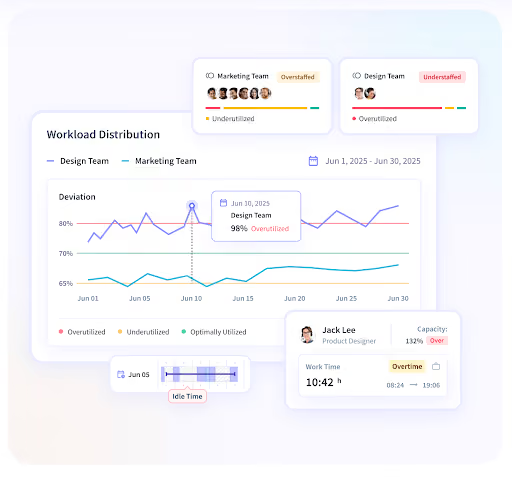
Start with your highest-cost processes: the 3-5 workflows that most directly impact revenue, delivery, or customer experience. The instinct is to monitor everything. The practical reality is that no organization has the bandwidth to act on everything, and attempting to do so produces data noise rather than decision-making clarity. The more tractable approach is to isolate the workflows where a breakdown has the most measurable downstream consequence.
Identifying those workflows manually is harder than it sounds. It typically requires interviews across departments, analysis of historical incident logs, and cross-referencing of cost reports. Workflow intelligence platforms compress this by surfacing time allocation patterns, tool usage frequency, and output volume by process type automatically, allowing leaders to identify which workflows consume the most resources relative to the revenue or delivery value they produce.
This is where platforms like Insightful enable a different approach. Instead of focusing on monitoring mechanics, they provide a data layer that shows how work happens across applications, teams, and locations, making unmapped workflows visible without compromising trust. The result is reduced process friction and clearer improved workflow optimization.
What Good Workflow Visibility Looks Like in Practice
When workflows are visible, operations shift from reactive to proactive.
Leaders can rebalance workloads before burnout occurs. Project scoping becomes grounded in actual time-on-task data. Headcount decisions are based on utilization rather than assumptions.
At Peach Payments, this level of visibility translated into a measurable outcome. Managers gained a clear view of how work flows across teams, tools, and locations. Within weeks, the rollout expanded across operations, finance, risk, fraud, and IT. It replaced fragmented reporting with a unified view of capacity and performance. With clearer productivity definitions and transparent dashboards, leadership identified high-performing remote teams and found employees were more productive from home.
This shift supported 40% business growth and a 22% increase in remote team productivity. By consolidating tools into one platform, teams saved hours of manual reporting each week and improved planning accuracy. In fact, they were able to drive the output of eight people with just two new hires. This shows how eliminating unmapped workflows and reducing workforce performance variances drives measurable gains without increasing headcount.
Closing the Visibility Gap
You cannot optimize what you cannot see. Unmapped workflows are not a minor operational issue; they are a direct P&L risk affecting capacity, margins, and retention. Organizations that build visibility into how work actually happens make better decisions across the board.
If you want to reduce workflow inefficiency and close workforce productivity gaps, the starting point is clear: make your workflows visible with Insightful.
FAQs
What is an unmapped workflow?
An unmapped workflow is a recurring process that operates without clear visibility, documentation, or data. Work gets completed, but leadership cannot see how it moves across teams, tools, or steps. These workflows often develop organically and remain hidden, making it difficult to identify inefficiencies, measure effort accurately, or improve outcomes.
How do unmapped workflows affect business profitability?
Unmapped workflows reduce effective capacity and lead to poor resource allocation. Teams spend time on low-value or redundant tasks that are not visible to leadership. This impacts project timelines, erodes margins, and increases operational costs. Over time, these inefficiencies compound, creating workforce productivity gaps that directly affect profitability and growth.
What tools give operations leaders workflow visibility?
Workforce analytics platforms provide visibility into how work happens across applications, teams, and locations. Unlike basic time tracking tools, they connect activity data to workflows and outcomes. This allows leaders to identify inefficiencies, improve utilization, and make informed decisions about staffing, capacity planning, and process optimization without relying on manual reporting.
How is workflow visibility different from employee monitoring?
Workflow visibility focuses on understanding how work flows through processes, not on tracking individual behavior. The goal is to identify inefficiencies, balance workloads, and improve outcomes at a system level. Employee monitoring often emphasizes oversight of individual activity, while workflow visibility provides aggregated insights that support better operational decisions without compromising trust.
Recommended for You

%20(1).webp)
.webp)